
Understanding Gilmer County Released Inmate Records
A release from the Gilmer County Adult Detention Center means the jail has ended that person’s local custody event. It does not always mean the person walked out to the community. The sheriff may release someone on bond, at the end of a sentence, under a court order, or into another agency’s custody. Once staff complete out-processing, the name ordinarily disappears from Current Inmates. The lasting evidence is the booking and release record, the court case, or the receiving agency’s record.
The operating agency matters. Sheriff Stacy L. Nicholson’s office holds the county book-in and release documentation. The Georgia Department of Corrections, or GDC, records a transfer into state custody and later state-prison discharge information. The State Board of Pardons and Paroles and Georgia Department of Community Supervision document different parts of post-release supervision. Federal Bureau of Prisons and ICE tools cover federal or immigration custody, not an ordinary county-jail discharge.
Gilmer County Release Types and Next Records
The release reason points to the next useful source. A person who posts bond may remain involved in an active criminal case. Someone who finishes a county sentence may have no further custody record, while a transfer produces another agency trail. Treat the word “released” as the end of one jail event, then confirm what happened next.
| Release type | Meaning | Where to check next |
|---|---|---|
| Bond or court order | Local custody ends while the case may continue | Gilmer court docket and sheriff release record |
| Sentence expiration or time served | The local confinement term is complete | Sheriff record and sentencing court |
| Probation | A court places the person under community supervision | Court sentence and Gilmer County DCS office |
| Parole | The Board permits supervised release from state prison | Parolee Search and DCS |
| GDC transfer | County custody ends because state custody begins | GDC offender search |
| ICE or other agency pickup | The person leaves the jail in another agency’s custody | Sheriff transfer field and the receiving locator |
Fields in a Gilmer County Release Record
Georgia law requires local jails to maintain inmate records, but no reviewed Gilmer public page promises that every release field appears online. The OffenderIndex system exposes detailed booking data and a prior-inmate search. For formal proof, request the book-in report and specifically identify the release information needed. That wording helps the records custodian distinguish a completed custody event from a current-roster inquiry.
| Field | What it establishes |
|---|---|
| Name and identifiers | Connects the record to the correct person and avoids a same-name error |
| Booking number and arrest date | Ties the discharge to a particular jail stay |
| Charges and arresting agency | Shows why the booking began and which agency initiated it |
| Release date and time | Marks when local custody ended |
| Release reason or type | Distinguishes bond, sentence completion, court action, or transfer |
| Destination or receiving agency | Indicates community release, GDC transfer, ICE pickup, or another jail |
| Bond, sentence, or hold data | Explains the authority controlling the custody event |
A prior booking row is useful, but it is not automatically a complete discharge certificate. If the exact time, legal reason, or destination matters, obtain the sheriff’s responsive record and compare it with the court disposition.
Request a Gilmer County Inmate Release Record
The sheriff provides a dedicated Open Records Request Form. A narrow request is easier to identify and estimate than a demand for every “inmate record.” Include enough booking detail to locate the correct stay, but do not send unrelated personal data.
- Identify the person, approximate booking period, and the Gilmer County Adult Detention Center.
- Ask for the book-in report plus release date, release time, release type, and transfer destination.
- Submit the sheriff form under O.C.G.A. 50-18-70 et seq. using the delivery directions on the form.
- Review the acknowledgment and cost estimate before approving chargeable retrieval or copies.
- Compare the response with the Clerk of Superior Court file when the release followed a court order.
1 Broad Street, Suite 103
Ellijay, GA 30540
Administration: 706-635-4162
Adult Detention Center: 706-635-4625
The form lists a $2 book-in report, $23.15 per hour for retrieval after the first 15 minutes, and 10 cents per page for CAD and miscellaneous paper copies. It says the office has three business days to acknowledge receipt and provide a cost estimate. Those are request charges, not a promise that every requested field is public.
Ask for Gilmer Release Details, Not “Inmate Records”
Gilmer’s fee schedule makes precision practical. Requesting the $2 book-in report alone may establish the booking, but a released-person inquiry should also name the discharge fields. Ask for the date and time local custody ended, the authority for release, and any transfer destination. If a responsive record is withheld or redacted, the agency should identify the legal basis that applies.
Retention for the public OffenderIndex history is not stated. Its “Include Previous Inmates In Search” option indicates that older booking entries may be searchable, and the site warns that such searches can take longer. That interface behavior is not a retention guarantee. The sheriff’s records response remains the direct way to learn whether a particular release document is maintained.
Georgia Law Behind Gilmer County Release Records
The sheriff form cites the Georgia Open Records Act, O.C.G.A. 50-18-70 et seq., and the fee authority in O.C.G.A. 50-18-71. Georgia Code 42-4-7 requires local jail inmate records and says a sentenced county inmate is released at sentence expiration less earned-time deductions. Access still depends on the record and any lawful exception. Juvenile, sealed, restricted, medical, or otherwise protected material may not be produced in the same manner as an ordinary jail log.
Booking photographs have an additional rule. O.C.G.A. 35-1-19 restricts law-enforcement disclosure when a photo may be published and removal requires payment. That restriction does not convert every booking and release fact into a confidential record.
Search for a Released Gilmer County Inmate
Start local and move outward only when the custody path calls for it. Gilmer does not publish a distinct released-last-24-hours feed, so the search must compare current custody with prior booking data before checking state, court, and federal systems.
- Open OffenderIndex for Gilmer County and check Current Inmates.
- Use Inmates by Booking Date, enter a reasonable range, and enable “Include Previous Inmates In Search” when available.
- Use Georgia VINE for a custody-status change or notification, not as a full release archive.
- Search GDC when the person may have transferred to state prison or completed a state sentence.
- Check the Gilmer court file for bond, dismissal, sentence, or later disposition.
- Use BOP or ICE only when federal or immigration custody is supported.
- Request the sheriff release record to confirm the exact date, reason, and destination.
The local 24-Hour Releases guide explains the booking-window workaround. If the question is when a sentence may end, the Release Date Lookup separates county, state, and federal date systems.
GDC Offender Search for Gilmer County Releases
The GDC offender query covers people in Georgia corrections records, including active and inactive records. It is not the complete roster of people released from the Gilmer jail. Use it when a county record indicates state transfer, or when the person served a state-prison sentence. The form can filter “Released In The Past 15 Days” and “Max Prison Term Ending Next 15 Days.”
| Search field | Best use |
|---|---|
| First, middle, last, or alias | Broaden or narrow a name search |
| GDC ID or case number | Reach a specific record directly |
| Age, gender, race, physical details | Separate people with similar names |
| Most recent institution | Test a known state placement |
| Sentence status and record scope | Include released or inactive state records |
| Primary offense and conviction county | Cross-check the correct court case |
The GDC Find an Offender overview leads to the official query form.
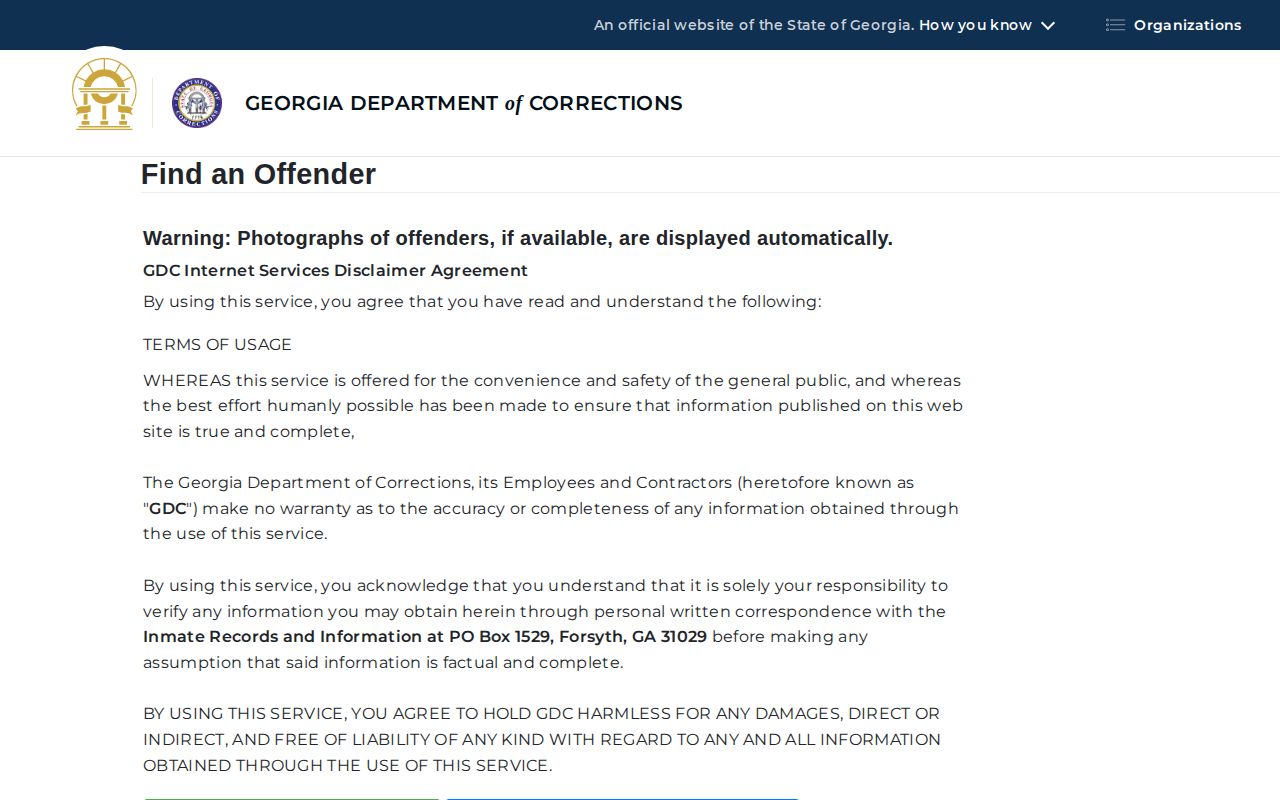
The sentence-status and active-or-inactive controls shown in the official search are what make it useful after a state offender leaves custody.
Gilmer County Recent Release Search Limits
OffenderIndex has Current Inmates, Bookings Over Last 24 Hours, and Inmates by Booking Date. The 24-hour tab reports new bookings, not releases. No official 24-hour or 72-hour release feed was found in the reviewed public sources. A three-day date range with previous inmates included can uncover a booking for someone no longer current, but it does not prove the discharge date.
Fields available in the local templates include name, sex, height, weight, arrest date and time, days in jail, arresting officer, total bond, charges, sentence, history, and other information. A photo slot exists in the template, but the reviewed configuration returns photos as disabled. Do not infer a mugshot or a release reason from an empty area.
Gilmer Release Searches Continue in Appalachian Circuit Records
Gilmer County belongs to the Appalachian Judicial Circuit with Fannin and Pickens counties. Superior Court has general jurisdiction that includes felony cases, while Magistrate Court handles matters such as preliminary hearings, warrants, certain minor offenses, and bail when it is not reserved to another court. Those records can explain why jail custody ended even after the roster entry disappears.
The circuit calendar states that criminal matters may be set by presenting a Rule Nisi through the Clerk of Superior Court and that incarcerated defendants participate by WebEx until further order. The Gilmer County Clerk of Superior Court, led by Amy Johnson, is the local custodian for criminal court records. A disposition, bond order, dismissal, or sentence should be read beside the sheriff release record, not used as a substitute for the jail’s actual out-processing time.
Check Gilmer County Post-Release Supervision
Parole and probation are not interchangeable. The State Board of Pardons and Paroles makes parole decisions and provides a parolee search. Georgia DCS performs field supervision, and the Appalachian Circuit program lists a Gilmer County DCS Office number of 706-502-8258. Probation normally comes from the sentencing court; parole follows a state prison sentence and Board action.
For a person still in state prison, the Tentative Parole Month lookup may show a review milestone, but the Board stresses that a TPM is not a final release decision. For someone already on parole, use the parolee database and confirm local supervision through DCS. The detailed Post-Release Supervision page separates these records and explains Georgia’s file-review process.
Gilmer Release Notifications and Federal Checks
Georgia VINE provides custody-status and criminal-case information with notification options. It can help track a participating Georgia custody event and alert a registrant to a change, but it is not the sheriff’s formal release packet. When a person is already absent from the roster, compare the VINE notice with the county record and court case.
The BOP inmate locator covers federal inmates from 1982 to the present. BOP explains that a past release date with no listed facility means the person was released from BOP custody on that date, though dates can change after credit recalculation. The USA.gov ICE guide explains searching the ICE locator by identifying information or A-number. Neither system should be used merely because a person is missing from Gilmer’s current roster.
When a Gilmer Jail Release Means ICE Transfer
Gilmer County’s own HB1105 report documents why destination matters. For the fourth quarter of 2024, it reports 308 bookings, 39 federal immigration-status inquiries, eight ICE detainers, and four ICE pickups. The report also provides response figures. Those data do not describe every released person, but they prove that an exit from the county jail can be a custodial handoff rather than community release.
When the sheriff record names ICE or another federal recipient, follow that transfer in the appropriate locator. ICE’s online system is designed for current ICE custody or certain recent CBP custody, while a local release record establishes what the Gilmer facility did. If no destination appears publicly, ask for the transfer field instead of assuming the person returned home.
Where Gilmer County Released Inmates Appear
Choose a system by custody type and time. Repeating the same name search in unrelated databases creates false negatives and same-name mistakes.
| System | Still in custody | After release |
|---|---|---|
| Gilmer Current Inmates | Primary local snapshot | Name normally drops off |
| OffenderIndex prior booking search | May show the booking | Can recover earlier booking data, not definitive release proof |
| Sheriff release record | Custody event remains open | Confirms local release date, type, and destination when maintained |
| GDC offender query | Shows qualifying state custody | Inactive or released state record may remain searchable |
| Georgia VINE | Custody status and alerts | May report a status change, not a full record |
| BOP locator | Federal facility and status | Past federal release date may remain |
Gilmer County Adult Detention Release Facility
The Gilmer County Adult Detention Center is the one local detention facility identified in the Facility Map. Sheriff materials place the physical detention operation at 106 Brett Dickey Memorial Drive in Ellijay. GDC’s administrative listing uses 1 Broad Street, the sheriff and courthouse location, with the same detention phone number. The facility page reconciles those addresses rather than treating them as two jails.
The center processes people taken into custody in Gilmer County regardless of arresting agency. It houses people awaiting trial, people serving court-ordered local sentences, and convicted people awaiting transfer to state prison. A community discharge leads back to sheriff and court records. A GDC, DCS, ICE, or other-agency handoff creates a second trail in the receiving system.