
Gilmer County Projected Release Dates
A projected date is a forecast based on the sentence, credit, custody status, and rules in force when the record is checked. An actual date is the day the person leaves that custody system. Those dates may match, but they answer different questions. A planned release can move after a court correction, lost credit, a new hold, transfer, parole action, or a break in sentence service.
The first split is between pretrial and sentenced custody. The Gilmer County Adult Detention Center houses people awaiting trial as well as people serving court-ordered sentences. A pretrial detainee does not have a sentence expiration to calculate. Bond may permit release, but another hold can prevent it. A sentenced county inmate has a local computation. Someone transferred to the Georgia Department of Corrections follows state-prison records instead.
| Custody track | Date or event to seek | Primary source |
|---|---|---|
| Gilmer pretrial custody | Bond, hold clearance, court order, dismissal, or transfer | Jail record and court docket |
| Gilmer county sentence | Sentence expiration less allowed earned time | Jail computation and sentence |
| Georgia state prison | Maximum Release Date and, if eligible, TPM | GDC and Parole Board |
| Federal prison | BOP release date | Federal inmate locator |
Find a Gilmer County Release Date
Identify where the person is now, not just where the arrest began. A person may leave the Gilmer jail roster because of release to the community, a transfer to GDC, movement to another jail, or an agency hold. The next step depends on that path. Search by a direct identifier when possible because names can be shared or entered in more than one form.
- Check the current Gilmer County custody source. If the person is still at the Adult Detention Center and is pretrial, ask whether a bond or hold exists rather than asking for a sentence end date.
- For a county sentence, obtain the sentencing order from the Clerk of Superior Court or other sentencing court. Ask the jail for the computed release date and applied jail or earned-time credit.
- For a state sentence, open the GDC offender query. Search both active and inactive records, then match the person by identifiers, conviction county, and institution.
- Check the Parole Board TPM Lookup only when parole timing applies. A TPM is not a release guarantee.
- For federal custody, use the BOP inmate locator. Federal dates do not come from Gilmer County or GDC.
- Confirm the actual event through the agency record. A past scheduled date without a release status is not enough.
The broader Gilmer County released-inmate record path explains how to request the county release date, release type, and transfer destination after someone drops off the live roster.
Note: A transfer out of Gilmer County custody can end the local jail stay without ending confinement.
Gilmer County GDC Release Fields
The GDC query covers Georgia state offenders, not ordinary county-jail detainees. It becomes relevant after a Gilmer County case results in state custody, after a transfer from the Adult Detention Center, or when a person has a prior state record. Conviction County can be set to Gilmer County, while Most Recent Institution contains historical or state-system labels. Neither choice proves current local jail custody.
GDC offers a name and attribute search plus direct GDC ID or case-number search. A GDC ID, also called a UNO, identifies the person. Case numbers identify an offense and may begin with letter pairs. Direct identifiers are more exact than name-only results.
| GDC control | Release-date use |
|---|---|
| Only Active Offenders | Checks current state incarceration. |
| Only Inactive Offenders | Looks for a person no longer in state custody. |
| Both Active and Inactive | Best first scope when status is unclear. |
| Released In The Past 15 Days | Finds recent state releases, not Gilmer jail releases. |
| Max Prison Term Ending Next 15 Days | Finds upcoming state maximum-term cases. |
| Conviction County | Connects a state sentence to a Gilmer County conviction. |
GDC warns that its public data may not be complete or fully accurate and directs users to verify information by written correspondence with Inmate Records and Information at PO Box 1529, Forsyth, GA 31029. Use the web result to locate the right record, then verify high-certainty sentence and discharge facts.
Gilmer County MRD and TPM
Georgia release-date language is not one field. GDC defines Maximum Release Date, or MRD, as the date the full judicial sentence would be served. It is also called max-out. The GDC handbook says the court sentence drives MRD and that the date changes only if sentence service is interrupted, unless parole or a court reduction changes when custody ends.
The State Board of Pardons and Paroles uses Tentative Parole Month, or TPM. A TPM marks the month when the Board expects to complete final review and may set a parole release date. It is not the MRD and not a final grant. Good conduct and required program completion can affect it. Misconduct may lead to postponement or cancellation.
The GDC terminology page displays the official MRD and TPM terms used in Georgia corrections.
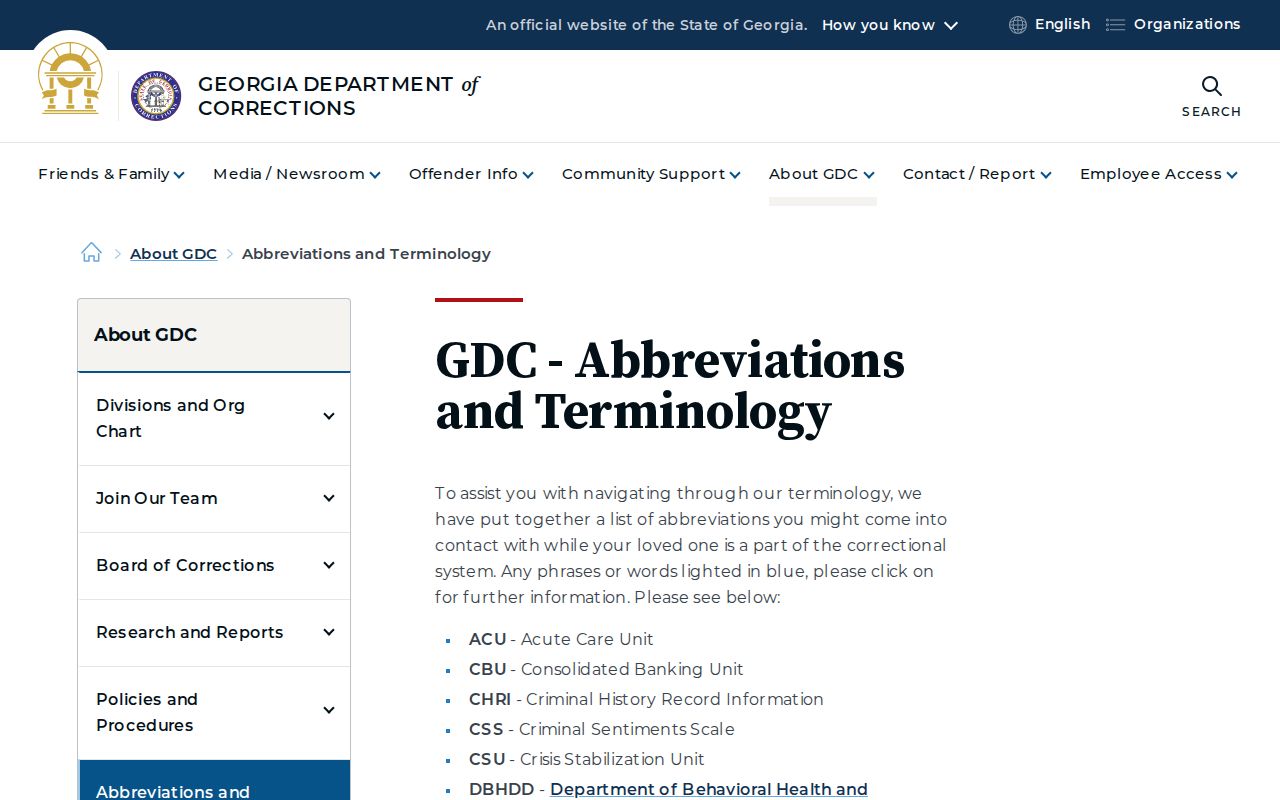
The definitions make clear why a person can have a maximum date and tentative parole timing in the same state record.
- MRD
- The maximum release date when the full judicial sentence would be served.
- TPM
- A tentative month for parole review, not a final release order.
- Earned time
- A deduction allowed under the governing custody rules when applied.
- Detainer
- A request or hold from another authority that can affect release from the present custodian.
Note: A TPM can move or disappear before release, while MRD describes the maximum sentence computation.
Gilmer County Jail Earned Time
County jail computation follows a different rule from state parole timing. O.C.G.A. 42-4-7 requires local jails to keep inmate records and says a county inmate sentenced to confinement is released at sentence expiration less earned-time deductions. In practice, the local calculation starts with sentence length, jail or time-served credit, and earned-time deductions if the jail applies them. Court or administrative corrections may also affect the result.
The statute does not turn every Gilmer County booking into a fixed projected date. It applies to a county inmate sentenced to confinement. A person awaiting trial may leave through bond, court action, dismissal, transfer, or hold clearance. For a sentenced person, the sheriff's computation and the actual court order must be read together.
The official text of Georgia Code 42-4-7 supplies the county-jail framework.
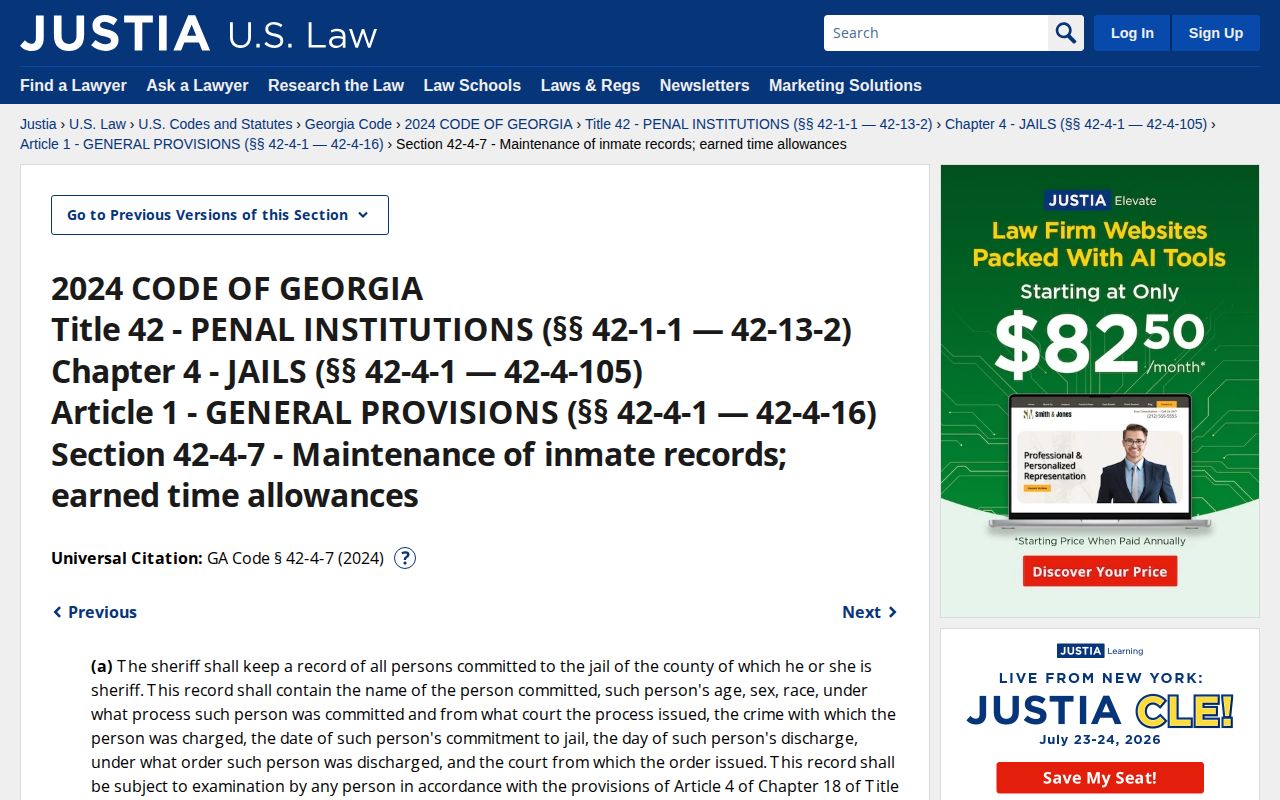
The statute supports asking the Gilmer jail for its computed date rather than applying a state-prison TPM to a county sentence.
Gilmer County Serious Felony Dates
Do not apply a blanket claim that every Georgia inmate serves a fixed percentage. O.C.G.A. 17-10-6.1 governs covered serious violent felony sentences and limits parole, early release, earned time, work release, leave, and other sentence reductions. The section contains sentence-specific rules, including parole timing for certain life sentences. Many covered terms must be served as imposed, subject to the exact statute and sentence.
Other Georgia state cases use the Board's eligibility rules and the person's sentence. County sentences use the local jail and court framework. This distinction matters in Gilmer County because an arrest at the local jail may lead to bond, a county term, probation, or later state imprisonment. The arrest location does not choose the release-date formula.
Read the serious violent felony statute with the sentencing order. Its restrictions should not be generalized to a charge that did not result in a covered sentence.
Why Gilmer County Dates Change
A projected date can move for legal, custodial, or administrative reasons. The cause should be confirmed in the source system. A later date is not proof of misconduct, and an earlier date is not proof that release occurred.
| Factor | Possible effect | Where to verify |
|---|---|---|
| Corrected sentence | Changes the term or credit basis | Sentencing court |
| Jail credit | Adds or corrects time already served | Court order and jail computation |
| Earned time | May shorten a county sentence when awarded | Gilmer jail record |
| Transfer to GDC | Moves computation to the state system | Release/transfer record and GDC |
| TPM action | May set, delay, cancel, or rescind parole timing | Parole Board |
| PIC credit | May reduce eligible state TPM or MRD | GDC |
| Detainer or hold | May prevent community release | Current custodian and holding agency |
GDC's Performance Incentive Credit program allows eligible state offenders to accumulate up to 12 PIC points, with a potential reduction of 1 to 12 months from TPM or MRD. GDC excludes several groups, including people with death sentences, terms of two years or less, non-parole-eligible offenses, listed minimum mandatory cases, and life sentences. The program does not apply to every Gilmer County case.
Note: Ask which agency changed the date and which record supports it before drawing a conclusion.
Gilmer County Federal Release Dates
A federal case uses the Bureau of Prisons system, even if a person once passed through a local jail under a federal arrangement. The BOP locator covers federal inmates from 1982 to the present. BOP says a release date may change because of First Step Act recalculation. When a listed release date is in the past and no facility appears, its records page says the person was released on that date and is no longer in BOP custody.
Do not copy a BOP date into a Gilmer jail timeline without marking it as federal. The county sheriff, GDC, Parole Board, and BOP are separate custodians. A U.S. Marshals hold or transfer can also mean that disappearance from a local roster was movement within custody rather than freedom in the community.
Confirm Gilmer County Release Events
Use a notification for a pending event and an agency record for final proof. Georgia VINE can send a custody-change alert for participating systems, but it is not a full jail release packet or court docket. The detailed VINE Inmate Check explains the alert and PIN process. After an alert, request the release date, release type, and destination from the sheriff when the event involved Gilmer County custody.
For state prison, confirm with GDC and distinguish inactive status from parole supervision. For county custody, compare the jail record and court disposition. For federal custody, retain the BOP result and verify any unexplained change with the federal custodian. Actual release is an event in the responsible agency's record, not a forecast inferred from a date alone.
A clean timeline can contain several dates: arrest, booking, sentence, transfer, MRD, TPM, actual release, and supervision discharge. Labeling each one preserves the distinction between Gilmer County jail release, Georgia prison release, federal release, and the later end of community supervision.