
Gilmer County Parole and Probation
Parole and probation can both require a person to report to the Georgia Department of Community Supervision, often called DCS, but they begin in different ways. The State Board of Pardons and Paroles may release an eligible state prisoner before the maximum sentence ends. That person serves the balance under parole conditions. A Gilmer County judge imposes probation as part of a criminal sentence. It may stand alone, follow jail or prison time, or run with another type of supervision.
The Appalachian Judicial Circuit identifies a local Felony Probation and Parole Program serving Fannin, Gilmer, and Pickens Counties. It says the program supervises adult felony probation, parole, and concurrently running misdemeanor probation. A misdemeanor case that is not concurrent may use a different court or provider path, so the sentence remains the key source.
| Point | Parole | Probation |
|---|---|---|
| Who creates the status | State Board of Pardons and Paroles | The sentencing court |
| Usual custody link | Release from a Georgia state prison sentence | May replace custody or follow time served |
| Best public check | Parolee Search and GDC offender record | Court sentence and DCS confirmation |
| Local supervision | Georgia DCS field supervision | Georgia DCS for felony cases and stated concurrent cases |
| End point | Discharge or sentence completion | Court-ordered term completed or changed by the court |
- Parole
- Conditional community release before the maximum state prison term ends.
- Probation
- A court-ordered period of community supervision.
- TPM
- Tentative Parole Month, a review marker that is not a final release date.
- Discharge
- The formal end of a custody or supervision term.
Verify Gilmer County Post-Release Supervision
Start with the system tied to the sentence. A person released from the Gilmer County Adult Detention Center after bond or dismissal is not automatically on supervision. Someone transferred into Georgia Department of Corrections custody may later appear in state parole records. A person sentenced in Gilmer Superior Court may have probation even when no parole record exists.
Use more than a same-name match. GDC offers name and identifying traits, as well as direct GDC ID or case-number searches. The Parolee Search accepts partial terms, so broad results need careful comparison. Public tools can point to a status, while the court and the responsible agency hold the formal records.
- Check the GDC offender query for active and inactive records. Use a GDC ID or case number when known.
- If the person remains in state prison, check the Inmate TPM Lookup. Treat a TPM as review timing, not proof of release.
- For a person believed to be out on parole, search the Georgia Parolee Database and compare all available identifiers.
- For probation, obtain the Gilmer County court sentence and identify the supervision term, level, and court that imposed it.
- Contact the Gilmer County DCS Office to confirm the right reporting office or ask how a public status question should be routed.
For the county release record that establishes when and how a person left jail, use the Gilmer County released-inmate search and records path.
Note: An inactive GDC record can show that state custody ended, but it does not by itself identify a current probation term.
Gilmer County DCS Supervision Office
The local layer is unusually clear. The Appalachian Judicial Circuit publishes the Gilmer County DCS Office number on its Felony Probation and Parole Program page. That page is the best public local source for adult felony probation, parole, and concurrently running misdemeanor probation in Gilmer County. It also names local staff, though assignments can change. Call the office rather than assuming that an older staff listing still reflects the case assignment.
Gilmer County DCS OfficeGeorgia Department of Community Supervision
Phone: 706-502-8258
Appalachian Circuit supervision details
DCS lists statewide agency hours as Monday through Friday, 8:00 a.m. to 5:00 p.m., and a statewide contact number of 678-783-4337. The State Board of Pardons and Paroles lists its parole and corrections call center at 404-656-4661 for parole consideration and eligibility questions. These are separate roles. DCS manages field supervision, while the Board makes parole decisions.
The local circuit spans three counties, so the office tied to a case may depend on residence, sentence, and assignment rather than the county of arrest alone. State the person's full name and known case or GDC number when requesting routing help. Do not ask the office to infer identity from a common name.
Gilmer County Parole Review Process
Georgia does not use an ordinary public inmate hearing for each parole decision. The Parole Handbook says a person in prison does not appear before the Board for the usual decision. Board members review the file one by one and vote. They do not meet as a group to decide an ordinary case. This is why no regular public parole-hearing calendar for a Gilmer County inmate was found.
The useful public substitutes are the TPM Lookup, the Parolee Search, the Board's process pages, and DCS supervision information. For most sentences other than life sentences, the Board may set a future TPM or deny parole when it considers the case. It may change a prior decision any time before release. A hearing examiner uses crime severity and a risk score to form a guideline recommendation, but that recommendation is not the same as a grant.
The full parole file is not an ordinary open file. The handbook cites O.C.G.A. 42-9-53 for its confidential or state-secret treatment, and it says people are not entitled to an explanation of the Board's decision. Public status is therefore limited. The Georgia parole process and lookup result give the sound public trail without implying a hearing that does not occur.
Note: Board meeting notices may concern agency business, but they are not a calendar of ordinary inmate parole-release hearings.
Gilmer County Parole Eligibility
Eligibility depends on the actual offense and sentence. The Board's guidelines use a crime-severity level and risk score, while O.C.G.A. 17-10-6.1 places strict limits on covered serious violent felony sentences. There is no sound shortcut based on an arrest charge or a rough fraction of time served.
The State Board eligibility and guidelines page shows the framework used in parole consideration.
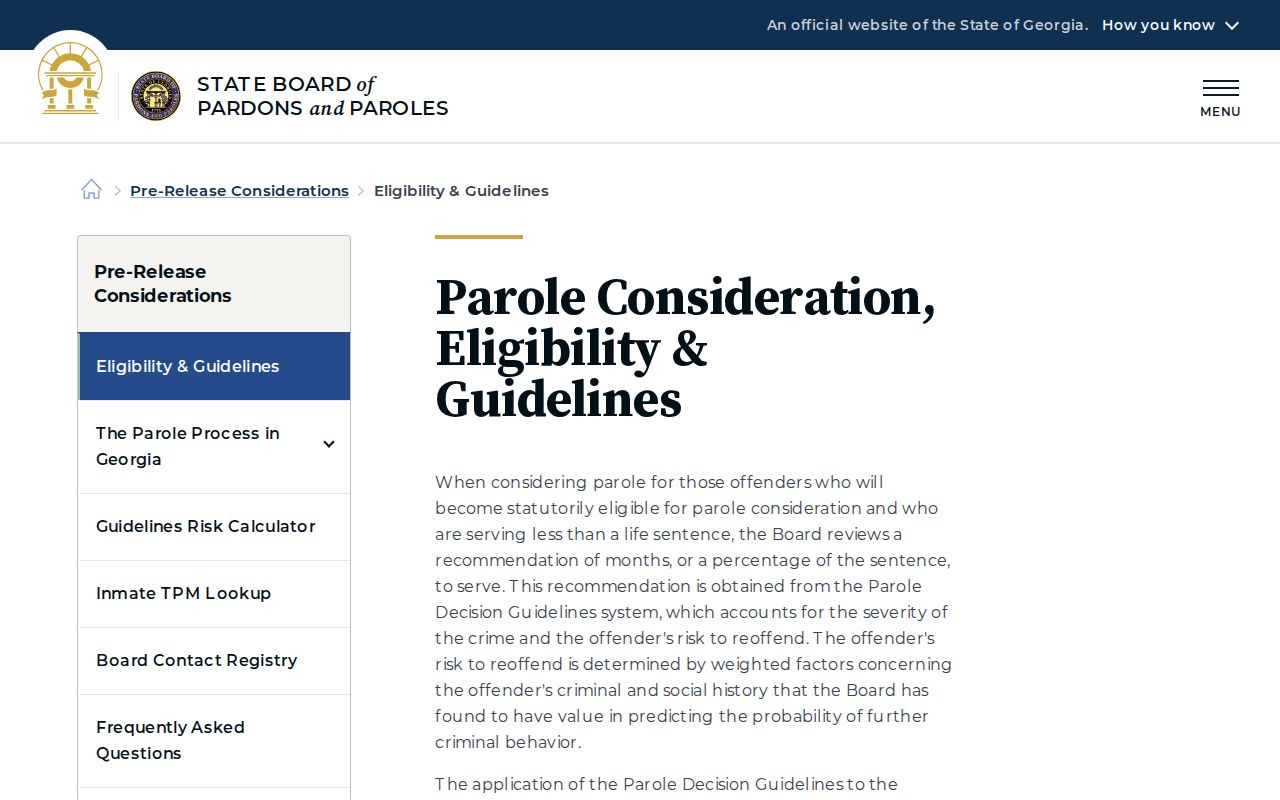
The official page helps explain the process, but a guideline grid does not confirm that a specific Gilmer County person has been granted release.
Gilmer County Supervision Violations
Parole and probation orders can impose reporting, program, payment, travel, residence, or conduct terms. The exact terms belong to the individual order. A violation can lead to added instructions, a warrant, a court action, or revocation proceedings, depending on the type of supervision and alleged conduct. An absconder is a person alleged to have stopped reporting or left supervision without approval. It is a status claim that should come from the responsible agency, not from rumor or a missing web result.
No Gilmer County public absconder list was found. For parole warrant or revocation status, use the Board and DCS path. A local warrant may instead be held by sheriff or court channels. Georgia VINE tracks custody and case events where participating data is available, but it is not a parole-warrant database and does not replace DCS confirmation.
If a person disappears from the Parolee Search, do not assume that supervision ended or that a warrant exists. Search spelling variants, compare the GDC record, and ask the agency which public record can confirm the status. A formal court entry may be needed for probation action.
Gilmer County Release Record Details
Supervision research often starts with a missing fact: the way the person left the Gilmer County Adult Detention Center. The sheriff's open-records form makes that request more precise. It lists a book-in report and identifies retrieval and copy charges. Ask for the book-in report together with release date, release time, release type, and transfer destination. Those fields can separate release to the community from transfer to GDC or another agency.
A transfer destination matters. A person moved into state custody has not completed the custody path merely because the county roster no longer lists them. Follow a GDC transfer with the offender query, then use TPM or parole tools only when those records apply. A person released after a court sentence to probation should be checked through the sentence and DCS instead.
The sheriff form cites the Georgia Open Records Act, O.C.G.A. 50-18-70 et seq., and cost authority under O.C.G.A. 50-18-71. It says the office has three business days to acknowledge a request and provide a cost estimate. That response window is not a promise that every record will be produced at once.
Note: Ask for named release fields and a date range so the records office can identify the correct jail event.
Gilmer County Supervision Discharge
Supervision ends through a formal act, not merely because an online result changes. Parole may run until discharge or sentence completion under the Board's authority. Probation normally ends when the court-ordered term is completed, unless a court changes it. Concurrent parole and probation can have different end points even when one DCS office supervises both.
Confirm the end through the agency tied to the status. For parole, compare the Parolee Search and GDC record, then seek Board clarification if the public result is not clear. For felony probation, use the sentence and later court entries, with DCS for field-office confirmation. A jail release record proves a custody event, but it does not prove that every later supervision duty has ended.
Keep the labels exact. Release from jail, release on parole, probation discharge, and GDC inactive status describe different events. Correct labels prevent a county jail date from being mistaken for a state discharge or a TPM from being treated as a final release.